
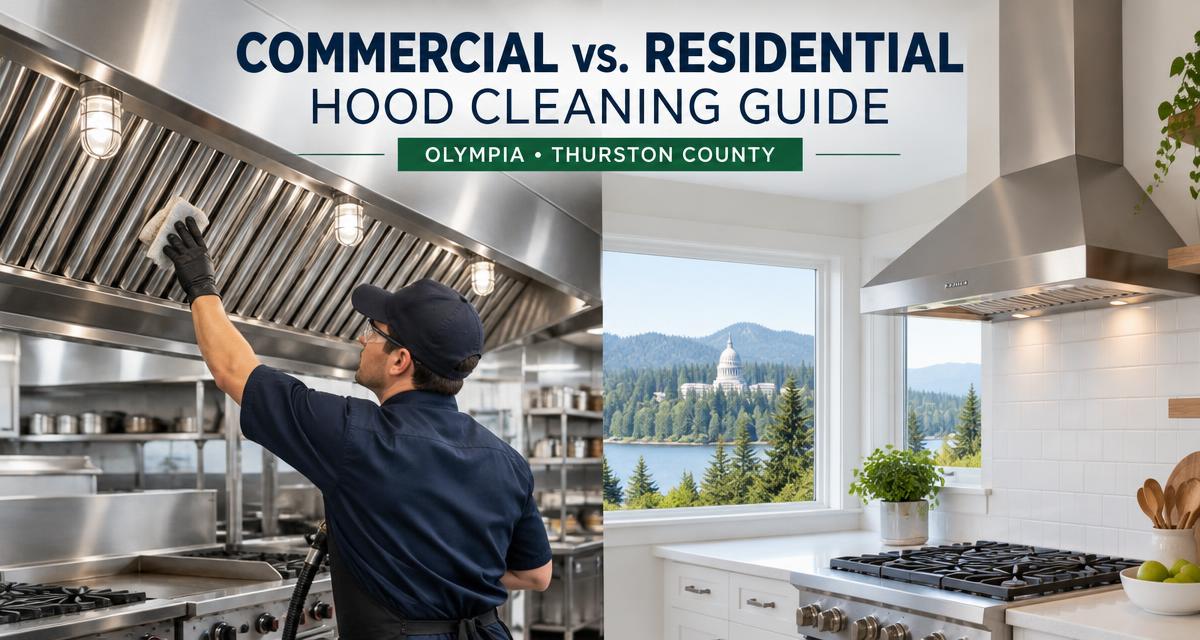
Commercial vs. Residential Kitchen Hood Cleaning: Olympia Property Owner's Guide
Grease does not stop at the visible face of a kitchen hood. It can collect on filters, inside the hood, around the plenum, through accessible ductwork, and at the exhaust fan. Whether you manage a restaurant in Olympia or cook every day at home in Lacey or Tumwater, the right cleaning service depends on the equipment, cooking volume, access, and the amount of buildup.
This guide explains the practical differences between commercial kitchen hood cleaning and residential kitchen hood cleaning, what a professional visit covers, and when to request an assessment from a local provider.
Commercial and residential hood cleaning solve different problems
A home range hood and a restaurant exhaust system both capture heat, smoke, vapor, and airborne grease, but they operate at very different scales. A residential service focuses on the range hood, reusable filters, and accessible parts of the home exhaust path. A commercial service addresses a larger grease-exhaust system and the operational needs of a food-service kitchen.
Residential kitchen hood cleaning
Residential service is designed for homeowners, vacation rentals, and property managers who need more than a surface wipe-down. Cornerstone's residential kitchen hood cleaning can include degreasing the hood interior and exterior, cleaning reusable filters and baffles, and addressing accessible ductwork and the exhaust fan.
It may be time to schedule service when:
- Grease returns quickly after the outside of the hood is wiped clean.
- Reusable filters remain sticky, dark, or difficult to clean.
- Cooking odors linger longer than they used to.
- The fan sounds strained or airflow feels weaker.
- You cannot safely reach the buildup behind the visible hood surfaces.
Commercial kitchen hood cleaning
Restaurants, food trucks, schools, healthcare kitchens, and other food-service operations produce more grease and often use larger exhaust systems. Commercial kitchen hood cleaning addresses the hood, filters, plenum, accessible ductwork, and exhaust fan as one connected system rather than treating the visible canopy alone.
For an Olympia-area business, a professional visit should also fit the kitchen's operating schedule. Cornerstone offers after-hours scheduling and provides before-and-after documentation and a service sticker after commercial work.
What a professional kitchen exhaust cleaning visit includes
The exact scope depends on the system and safe access, but a complete assessment follows the grease path instead of stopping at the stainless-steel surface. Cornerstone's kitchen hood cleaning service evaluates the system and builds the work around the equipment on site.
- Inspection: The technician reviews the hood, filters, plenum, duct access, fan, and visible grease load.
- Protection: Cooking surfaces and the surrounding work area are covered before degreasing begins.
- Filter and hood cleaning: Removable components and hood surfaces are treated for accumulated grease and residue.
- Exhaust-path cleaning: Accessible sections of the plenum, ductwork, and fan are cleaned according to the agreed scope.
- Review: The work area is cleaned, the system is reviewed, and commercial customers receive documentation of the completed visit.
How often should a kitchen hood be cleaned?
There is no useful one-size-fits-all calendar. Cooking volume, fuel type, menu, filter condition, and the existing grease load all affect the appropriate interval.
For homes, Cornerstone generally recommends a professional deep cleaning every 6 to 12 months, with more frequent attention for heavy frying or daily high-volume cooking. Washable filters should still be checked and cleaned between professional visits according to the equipment manufacturer's instructions.
Commercial schedules are based on the operation and applicable requirements. Cornerstone's service guidance uses monthly cleaning for solid-fuel or very high-volume operations, quarterly cleaning for many moderate-volume kitchens, semiannual cleaning for lower-volume operations, and annual cleaning for limited-use systems such as some seasonal facilities. A site assessment is the best way to confirm the appropriate plan for a specific kitchen.
Questions to ask before hiring a hood-cleaning company
- Will the scope cover the full accessible exhaust path or only the visible hood?
- How will nearby equipment and surfaces be protected?
- Can the visit be scheduled around the kitchen's operating hours?
- What documentation is provided after commercial service?
- Will the quote identify any access limitations before work begins?
- Can the same local team support both a commercial property and a residential kitchen?
Clear answers help owners compare scope rather than choosing on a headline price that may not cover the same work.
Local hood cleaning for Olympia and Thurston County
Cornerstone Home Professionals serves homes and food-service kitchens in Olympia, Lacey, Tumwater, and surrounding South Sound communities. The commercial and residential service tracks share one goal: remove accumulated grease from the accessible system so the kitchen is cleaner and the ventilation can do its job.
The service was introduced for both property types in 2026; readers can also see the original Thurston County hood-cleaning announcement. Homeowners planning a broader renovation can pair ventilation maintenance with Cornerstone's Thurston County kitchen remodeling guide.
Choose the right service for your kitchen
If you operate a restaurant or institutional kitchen, start with the commercial hood-cleaning service. If you need help with a range hood at home or in a rental property, review the residential service. For a written estimate based on your equipment and access, request a free hood-cleaning quote or contact Cornerstone Home Professionals.